
The Earthquake You Don’t Want to Prepare for… After It Happens!
Why Forward-Thinking Data Centers Are Rethinking Seismic Protection for Critical Computing Infrastructure
Earthquakes have a way of renewing interest in seismic protection.
A significant event occurs somewhere along the Pacific Ring of Fire or another active seismic region, images of the damage appear, and for a short period earthquake preparedness moves higher on the priority list.
Then attention moves elsewhere.
For operators of data centers, AI factories, high-performance computing facilities and other mission-critical environments, that reactionary cycle deserves reconsideration.
The objective of seismic resilience should not be to respond to the earthquake that just happened.
It should be to prepare for the one that eventually will.
And as the value, weight and importance of computing infrastructure continue to increase, that distinction is becoming considerably more important.
Earthquake Risk Hasn’t Gone Away
Recent seismic activity around the Pacific Ring of Fire and elsewhere in the world has been another reminder that the forces creating earthquakes are continuously at work.
California remains one of the world’s most closely studied seismic regions. The San Andreas and numerous other active faults continue accumulating and releasing tectonic stress.
No credible scientist can tell us the date of the next major California earthquake.
That is precisely the point.
Earthquakes cannot presently be scheduled or reliably predicted. They can, however, be anticipated as a long-term infrastructure risk.
The question for organizations responsible for critical computing infrastructure therefore shouldn’t simply be:
Will another major earthquake occur?
A more useful question is:
What will happen to our critical equipment when it does?
That is not a prediction.
It is risk management.
Computing Is Becoming More Valuable—and Moving Closer to People
At the same time seismic risk remains present, the architecture of computing is changing dramatically.
AI inference, edge computing, telecommunications, healthcare applications, autonomous systems and other latency-sensitive workloads are creating powerful incentives to position computing resources closer to the people, devices and organizations consuming them.
There are compelling reasons for doing so.
Lower latency. Faster response. Reduced network dependency. Local processing. Improved user experience.
But there is an unintended consequence.
As compute moves closer to major population centers, increasingly valuable infrastructure can also move closer to seismic risk.
Los Angeles, San Francisco, Seattle, Portland, Tokyo and many other technology-intensive population centers are located in seismically active regions.
That doesn’t mean computing infrastructure shouldn’t be located there.
It means the infrastructure should be designed with that reality in mind.
Today’s Rack Is Not Yesterday’s Rack
The economics of the data center have also changed.
A rack is no longer necessarily a relatively inexpensive enclosure filled with easily replaceable IT equipment.
AI and high-performance computing are creating extraordinary compute density. GPUs, liquid cooling, high-power distribution, storage and sophisticated networking can concentrate tremendous financial and operational value into a remarkably small footprint.
The racks themselves are also becoming heavier.
Much heavier.
That changes the seismic risk equation.
When millions of dollars of technology—and perhaps considerably more in associated computing capacity—can be concentrated into a relatively small area, protecting the enclosure from overturning may no longer be a sufficient objective.
The more important question becomes:
How much earthquake energy reaches the equipment inside it?
Protecting the Building Isn’t the Same as Protecting the Equipment
Modern seismic building codes have made enormous advances in protecting structures and human life.
But a building surviving an earthquake does not necessarily mean the equipment inside it remains operational.
For a mission-critical facility, that distinction can be enormous.
The building may perform exactly as designed while racks, servers, storage systems, network connections, cooling connections and other equipment experience substantial acceleration.
That is why equipment-level seismic protection deserves its own engineering discussion.
And it leads to an important distinction between anchoring and isolation.
Anchoring and Isolation Solve Different Problems
Conventional seismic protection frequently begins with a straightforward concept:
Bolt the equipment to the building.
Anchoring can be extremely effective at preventing equipment from overturning or moving uncontrollably.
But anchoring also creates a rigid mechanical relationship between the equipment and the structure supporting it.
When the floor accelerates, the anchored rack is forced to respond to that movement.
The rack may remain standing—which is certainly important—but the seismic acceleration can still be transmitted through the rack structure to servers, storage systems, networking equipment, circuit boards, connectors and cooling infrastructure.
And because racks are tall structures, their response at the top can differ significantly from the motion occurring at floor level.
Base isolation approaches the problem differently.
Instead of asking:
How strongly can we attach the equipment to the moving floor?
It asks:
How much of the floor’s movement actually needs to reach the equipment?
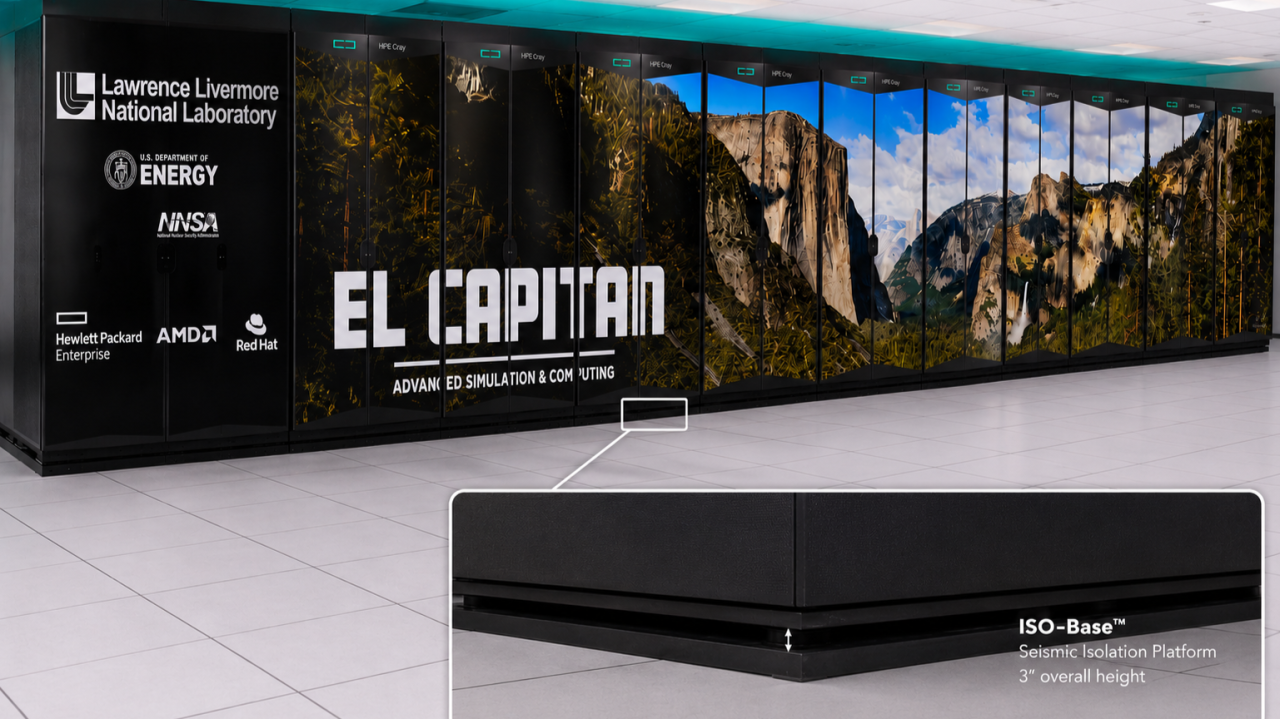
That is the engineering principle behind ISO-Base™ seismic isolation.
Let the Floor Move
ISO-Base creates a controlled isolation plane between critical equipment and the supporting floor.
During an earthquake, the building and floor can move while the isolated equipment is allowed to respond independently, substantially reducing the seismic acceleration and forces transmitted into the equipment.
The concept is remarkably simple:
Instead of forcing critical equipment to follow the earthquake, allow the earthquake to move beneath it.
And it can be accomplished without putting racks on a massive mechanical structure.
The standard ISO-Base platform has an overall height of approximately three inches.
Its low profile allows the isolation system to become an almost invisible part of the infrastructure.
Talk to our team to learn how you can secure your critical equipment today.